An AI agent that picks up every failed data-entry test in your analytics warehouse, investigates the record behind it, fixes it in the source system when it is sure, and hands everything else to the right test owner as a ready-to-act list in Slack.
Your warehouse
Per failing record
Always
High confidence, own data
Everything else
Screenshots from the current version, captured 14 September 2026 on our John's Cleaning demo client: a cleaning company whose operations portal, Exact Online, HubSpot, Nmbrs payroll and Mollie all have to agree with each other.
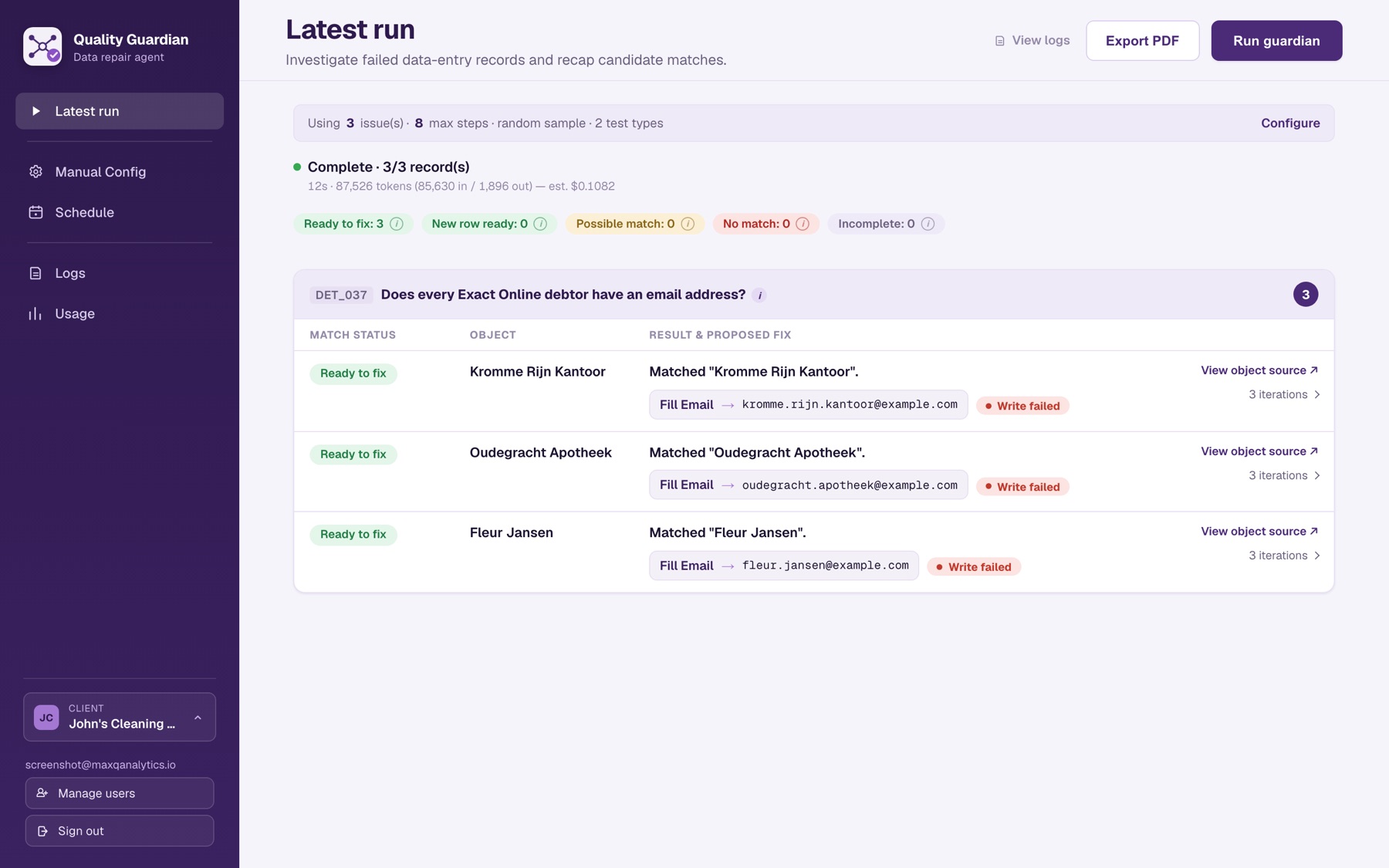
The run header shows the scope it used. Five verdict counters split the records: Ready to fix, New row ready, Possible match, No match, Incomplete. Each row names the object, the proposed fix, whether it was written, and links to the record in its source system.
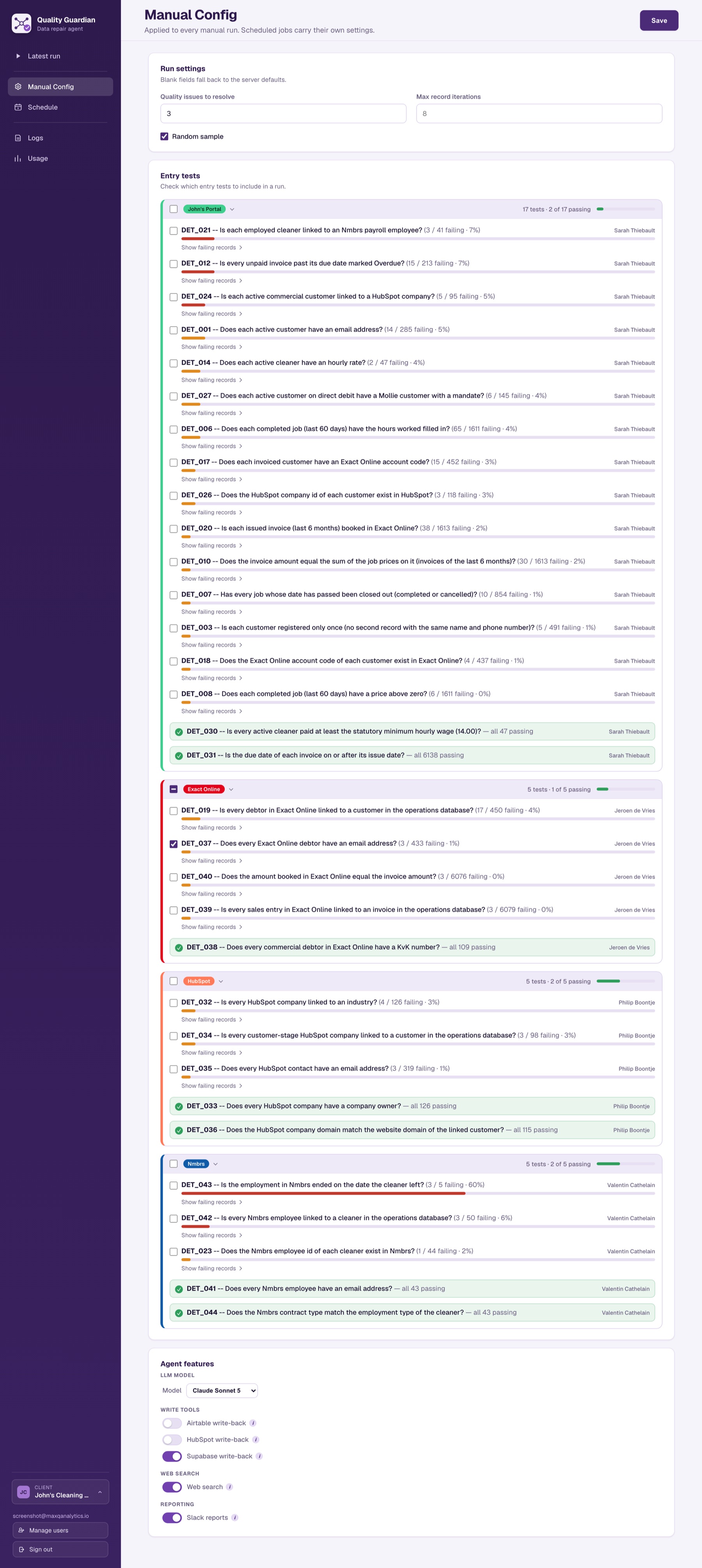
Tests are grouped per source system, each with its failing count, pass rate and owner, and a link to the failing records. Tick the tests a run should cover, set how many issues to resolve and how many investigation steps each record may take, and choose a random sample or the most recent failures.
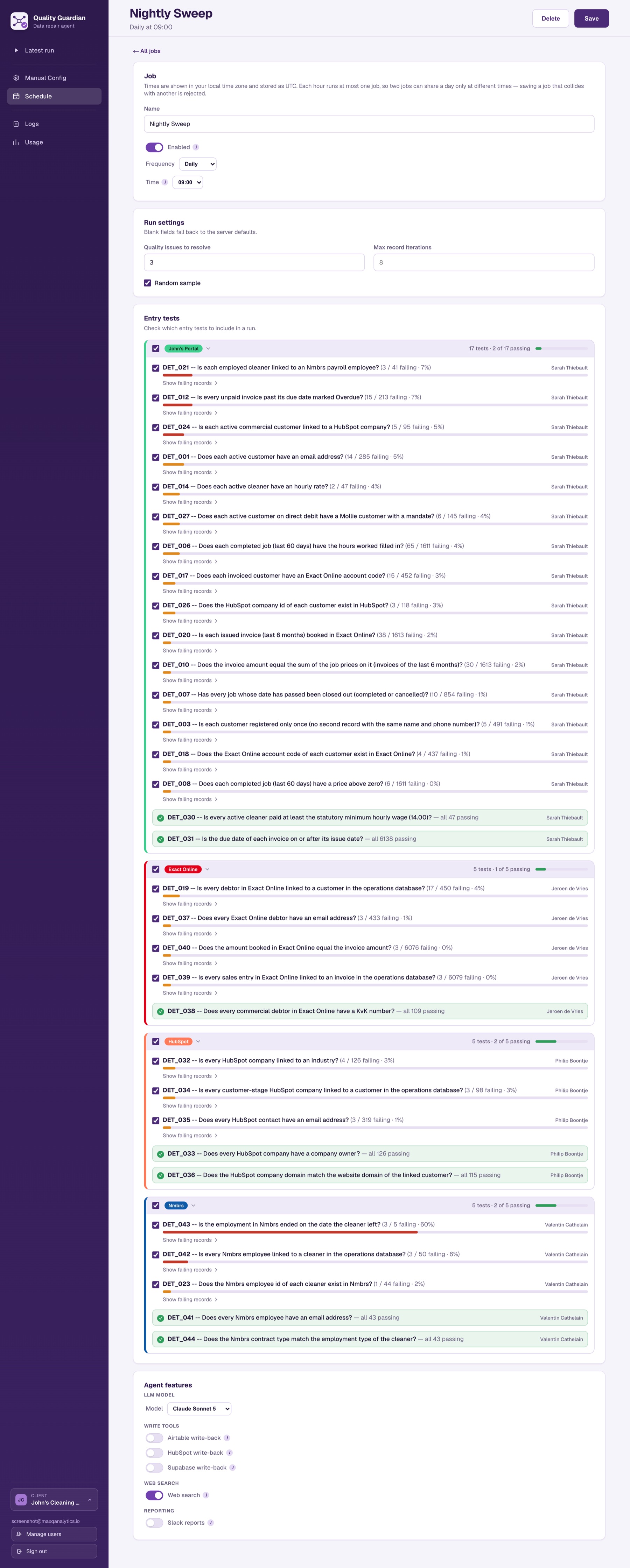
Create jobs that run daily, weekly or monthly at an hour you pick, shown in your local time. Each job carries its own run settings, so a nightly sweep can cover every test while a Monday job focuses on invoices only. A scheduled run is labelled with its job name in the logs.
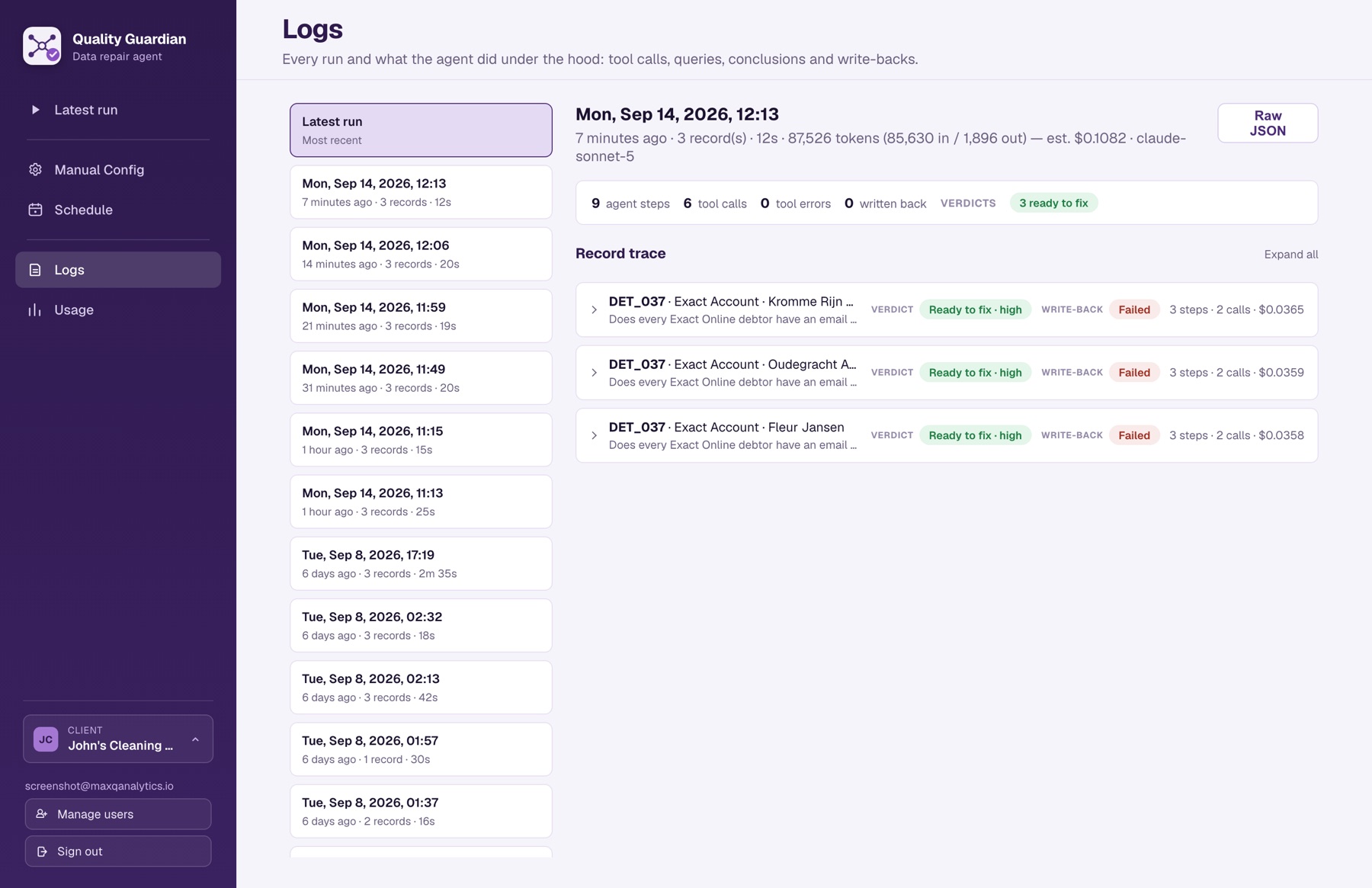
Every run is kept. Pick one and see its model, the number of agent steps, tool calls and tool errors, and how many records were written back. Each record carries two labelled chips: the verdict the investigation reached, with its confidence, and the write-back state: written, dry-run, failed, not configured, skipped as duplicate, or not attempted.
Posted to a channel of your choice after each run. The layout is fixed on purpose: the same four labels on every card, so a test owner can act on it, or paste it into their own assistant.
3 fixed automatically · 2 require test owner action
John's Cleaning · 14 Sep 2026, 09:04 · 5 records · Open logs
FIXED ENTRY ISSUES (3)
DET_012 · Invoice INV-2026-05498 · Status set to Overdue · written to John's Portal
DET_012 · Invoice INV-2026-04360 · Status set to Overdue · written to John's Portal
DET_012 · Invoice INV-2026-05718 · Status set to Overdue · written to John's Portal
REQUIRES TEST OWNER ACTION — Marieke de Jong (2)
DET_021-1 · Cleaner Fleur Jansen · Verify, then set
Issue Employed cleaner is not linked to an Nmbrs payroll employee.
Found One Nmbrs employee "F. Jansen" with the same start date and email domain; no employee id stored on the cleaner.
Action Confirm it is the same person, then set nmbrs_employee_id to 10482.
Where John's Portal › Cleaner › cln_7f3a… · Open record
DET_024-1 · Customer Bakkerij De Molen · Create the row
Issue Active commercial customer has no HubSpot company.
Found No HubSpot company matches the name, domain or Exact account code. Customer is active with three jobs this month.
Action Create the HubSpot company with name, domain demolen.nl and the Exact account code 1042.
Where John's Portal › Customer › cus_2b91… · Open record
Your assistant can work from this section as-is, using your own access to the named systems.
Layout as shipped on 14 September 2026. Record details in this example are illustrative.
Freeday builds AI digital employees for customer service and finance teams. Maxq runs their analytics stack: Airbyte, dbt and Cube on Snowflake.
Freeday's customer data lives in three systems that have to agree: HubSpot for companies and deals, Airtable for operations and the digital employees, Exact Online for invoicing. A company sold in HubSpot but missing in Airtable, or a customer without its Exact account code, means a digital employee that cannot be provisioned or an invoice that cannot be sent. The data-entry tests in their dbt project catch these every morning. Fixing them by hand did not scale.
Plain-language tests per object and source system, each with a named test owner, failing count and pass rate. Defined once in your dbt project; the guardian reads the failures.
Read-only SQL over curated tables, web search as fallback, a step budget per record, and a verdict with high, medium or low confidence every time. Only candidates from your own data qualify for an automatic fix.
Field fills and row creation in Airtable, HubSpot or your operations database. Off by default, one switch per system, dry-run reporting while off, duplicate check before any create, and the outcome stored on every record.
After each run: what was fixed, and a section per test owner with Issue, Found, Action and Where per record. Fixed labels, a link to the record, and a deep link to the run's logs.
Daily, weekly or monthly jobs at the hour you choose, each with its own run settings. One job per slot, enforced when you save. Runs show which job triggered them.
Every run is kept with its model, steps, tool calls and errors. Per record: the verdict, the write-back state, and the complete investigation trace. Raw JSON on request.
A branded PDF per run, manual-action records first. A period report over any date range that collapses repeated failures into distinct open issues, with how often each was seen.
Email and password sign-in for your team, invite links to add colleagues, and a user list to remove them. Nothing is reachable without a session.
The model reasons and concludes. Code decides what gets written, and to where.
Read-only, end to end. A SQL guard limits the agent to single SELECT statements over a fixed allow-list of curated tables, with a row limit appended automatically. Snowflake and BigQuery are supported.
Claude Sonnet 5 by default, Sonnet 4.6 selectable, routed through the Vercel AI Gateway. No static API keys in the deployment.
The model has no working write or messaging tool. Write-back and the Slack report are separate, code-controlled steps that run after the conclusion, each behind its own switch.
Next.js on Vercel, fully managed. Run history, settings, jobs and accounts live in Vercel Blob storage with versioned keys. No database to run, nothing to install on your side.
Hourly cron ticks, each checking which job is due. The cron endpoint is protected by its own secret and is the only route that bypasses the login.
Up to three records investigated in parallel, each with its own warehouse connection. Configurable record limit and step cap per record, with one reserved step so a capped record still ends with a verdict.
Operations and finance teams whose numbers depend on several systems agreeing with each other: an operations portal, the accounting package, the CRM, payroll, the payment provider. When a customer is missing in one of them, or a status was never updated, the invoice is wrong, the report is wrong, or the automation breaks.
It works best when data-entry tests already exist or can be written quickly, and when there is a named owner per test. The guardian does the investigating and the safe fixes; the owner keeps the judgement calls, with the homework done.
Each owner's section delivered as a thread, mention or direct message instead of one channel post, and a "resolved since last run" count in the header once the previous run's records are re-checked against the tests.
Per-test remediation instructions from your data model become the leading input for how a fix is made. And an applied fix can be reverted from the dashboard, because a high-confidence verdict can still be wrong.
Records and fixes aggregated per week, month or quarter, and the share of investigations that led to a fix. Plus a dedicated client domain and several jobs running in parallel.
Two components. An implementation fee covers writing the data-entry tests for your systems, connecting the warehouse and the source systems, and setting up write-back, Slack and the schedule. An ongoing licence covers hosting, model usage and keeping the tests and the agent maintained.
The licence scales with the number of tests under watch, so a focused setup on invoices and customers pays less than coverage across every system. We scope the exact structure together based on your context.
Implementation fee
Tests, connections, write-back and Slack setup.
Licence fee
Hosting, model usage and maintenance, scaled by tests under watch.
Product Owner
Founder · Maxq Analytics
Philip built the Quality Guardian: the investigation agent, the guarded write-back, the scheduling and the Slack report. He shapes the product around the data-quality problems he sees at Maxq's clients, and runs the demo client it is developed against.
Developer & Maintainer
Medior Data Engineer · Maxq Analytics
Valentin develops the Quality Guardian with Philip, from test configuration to client-side implementation across environments.
In a live demo we walk through a real morning run. From there: we connect the Quality Guardian to your analytics warehouse, add data-entry tests to your dbt project with an owner per test, plug in the source systems it may write to, and switch on the schedule and the Slack report. The first fixes land within the first weeks.
Schedule live demo